
When it comes to resistance training, there is not a “one
size fits all” training method. Of course there are guidelines in addition to your
individual goals that you can use to create your routines but where do you
begin? What does it mean to train for muscular strength versus muscular hypertrophy
versus muscular endurance? Which training method best targets your goals?
Let’s start by examining the difference between the methods
I just mentioned. Please remember everyone is different and this post provides
general information. I encourage you to seek advice from a trainer if you are
just getting involved in strength training or have any questions. With that being said, muscular endurance is a
great starting point for any of you that are very new to weight training.
Endurance training focuses on ‘lighter weights for more
repetitions’, aiming to complete 12 or more repetitions over 3 sets. Rest
periods are short, ranging 30-60 seconds between sets. For example, performing 3
sets of 20 leg extensions using a lighter weight might be included in an
endurance program. Although the amount of weight lifted is considered lighter
(compared to strength and hypertrophy training), you still want to use a weight
that challenges you on your last 2-3 repetitions. If you finish your 20
repetitions and feel like you could keep going for another 5 or more, it is
time to increase your weight. Endurance training is commonly used among endurance
athletes such as distance runners and usually involves total body workouts.
Hypertrophy… You might be thinking hyper-what? Muscular hypertrophy
is an increase in the size of skeletal muscle by an increase in the size of its
cells via sarcoplasmic and myofibillar hypertrophy. In other words, hypertrophy
is an increase in muscle mass and cross-sectional area. Increasing your lean
muscle mass improves strength and stamina, helps manage insulin sensitivity,
increases your basal (resting) metabolic rate, and can aid in body fat
reduction. Training for hypertrophy includes 3-5 sets of 8-12 repetitions,
resting anywhere from 1-3 minutes between sets. When training for hypertrophy
the weight selected should leave you feeling fatigued by the end of your set ie
it is challenging to complete your last couple repetitions. Hypertrophy
training programs are commonly split up, so you are focusing on one to two
muscle groups per training session (again, this is a guideline). This type of
programming allows sufficient recovery time and allows you to train more days of
the week.
 When training for muscular strength, the goal is to lift a
heavy weight for only a few reps (few meaning 6 or less). Strength programs are
widely used among athletes and individuals who want to increase their strength.
I personally like lifting heavy and pushing myself to lift heavier each training
session. When programming for strength, a typical training session involves
performing 3-6 repetitions (this will greatly vary, for example if you are
performing a 1 RM, it is just one) and 3-5 sets. The weight that’s selected
generally is a percentage of the 1 RM but it should be heavy enough that set is
challenging while keeping good form. Rest can vary anywhere from 3-5 minutes
(maybe even more) but should allow for recovery before performing the next set.
It is always a good idea to use a spotter when lifting heavy and practice good
form with any program! **Power is also
an area of resistance training utilizing explosive lifts and difficult
techniques, and I will touch on this one at a later time.
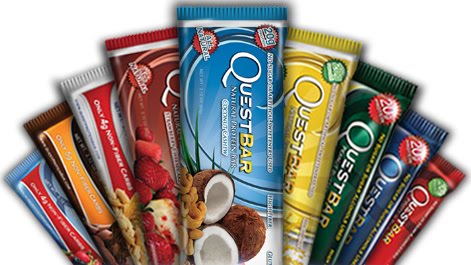
I love giveaways, especially when I WIN!! J I also love sharing
things that I love because I get pretty dang excited for others to try them! I have been asked a few times where to
purchase Quest Bars after I posted them in Friday Favorites. SOOOOOO… I am giving away a bundle of 5 Quest
Bars! Here is how to enter the drawing…
- Answer the following question... What is your favorite outdoor physical activity??
- Comment on this post with your answer
- Winner will be randomly selected and announced in Fridays post
Take care of you!
J




 Advocare Muscle Gain- I am really big into Advocare products and love the results I see from using them. The muscle gain is one of my favorite products right now and it provides the perfect combination of amino acids, whey protein blend, and carbohydrates for a post-workout meal. I can either toss a packet in my gym bag or throw a couple scoops in my shaker. The chocolate is divine and mixes well with water or I will blend it with almond milk, a TBSP of almond butter and ice for a thick shake.
 True Nutrition Whey Protein Isolate Cold-Filtration- I love this product especially for my post-workout recovery mix or late night meals. The cold-filtration process separates the proteins through the use of microfiltering the mass while using a cold environment. This process allows the protein to be removed from the unwanted fat, lactose, and the like. Cold-Filtration Isolate is almost fat free and lactose free, so late at night it does not cause any stomach issues. There are many many flavors and you can choose additional add-ins such as extra carbohydrates or a vitamin-mineral mix. You also have the opportunity to add the type of sweetener you would like used such as stevia, Splenda or go with unsweetened. My favorite is Dutch Chocolate Fudge! I have turned it into hot cocoa or a chocolate mug cake!
 Advocare Nighttime Recovery- This stuff is amazing! I have been taking two at night and have noticed a huge difference in my body’s ability to recover from tough workouts. Actually, I notice the biggest difference when I DON’T take them! I wake up feeling like I got run over by a MAC truck when I forget to take the nighttime recovery supplement. It is made of amino acids, minerals, and root/vegetable extracts and helps support muscle repair and growth while you sleep.
 Quest Bars- I don’t eat very many protein bars, in fact I am very picky about which ones I eat because there are many that are filled with additives and crap I can’t even pronounce (the same holds true for protein powders). Quest bars seem to be a “better alternative”, meaning less of the artificial stuff and more whole food ingredients than most bars (of course nothing compares to simply eating whole foods!) They are lower in sugar and carbohydrates while providing 20 g protein for under 200 calories. But sometimes when you are on the run and you need something ASAP before you get to Hangry (that angry feeling from being hungry) they can be a lifesaver. I use them as a treat when I have a really bad sweet tooth or will incorporate them into a cheat meal. The chocolate chip cookie dough is my favorite. I will cut of a SMALL piece and heat in the microwave for 10 seconds creating a cookie dough-like treat.
 ARO Fruit Punch Glutamine- Most of the supplements we purchase come from Vitacost because they have free shipping for orders over $49 and they always have Bogo specials or close-out deals that you won’t find anywhere else. The ARO (which is Vitacost’s own brand) product line is great and we use the fruit punch pre-workout and the fruit punch glutamine. Glutamine is one of the 20 amino acids that make up the body. It plays a role in protein synthesis, regulation of acid-base balance and is an awesome recovery agent that I take it multiple times a day. I like the flavored kind to throw in my ice water, not only will I drink the whole glass but it makes it tolerable to do so. It also goes great in my pre-workout because they have the same flavor and it adds an extra dose to my day.
 Yogi Stress Relief Tea- I love the Yogi brand of teas and use quite a few of them! My favorites are Kava Stress Relief, Detox, ginger, and Cinnamon Vanilla Healthy skin. I use these throughout the day depending on how I am feeling and drink a cup of kava stress relief mixed with soothing Caramel Bedtime almost every night before bed. It fills me up when I want to snack and relaxes my body before hitting the sack. Tea has so many great benefits for your well being, so much so I will have to do a post on it soon!


 Bicep Curl- Stand with your feet
shoulder-width apart. Hold dumbbells in each hand in front of your hips, palms
facing out. Curl your right hand toward your shoulder. Then lower it back down
to the start position. Repeat with the left arm. Alternate sides for 4 sets of
8-10.
 Tricep Dip- Sit on the edge of a
bench or chair with your feet together. Place your hands on the seat on each
side of your thighs and keep your feet flat on the floor. Bend your elbows 90
degrees and lower yourself toward the floor. Straighten your arms, raising your
body back to the start position. Perform 4 sets of 10.
 Hammer Curl- Stand with your feet shoulder-width apart. Hold
dumbbells in each hand in front of your hips, palms facing towards each other. Curl
your right and left hand toward your shoulders. Then lower back down to the
start position. Repeat for 4 sets of 8-10.
 Overhead tricep extension- Stand with your feet
shoulder-width apart. Hold a dumbbell (by the weight part) overhead with your
upper arm almost touching your ears and your elbows facing forward. Extend forearm overhead until arms are
straight. Lower until forearms in the starting position. Repeat for 4 sets of
10.
 Reverse Bicep Curl- Stand with your feet shoulder-width
apart. Hold a straight bar in front of your hips, palms facing down towards the
ground. Curl your right and left hand toward your shoulders. Then lower back
down to the start position. Repeat for 4 sets of 8-10.
 Tricep Pushup- Set up in the plank position with your hands closer
than shoulder-width apart. Lower your chest toward the floor while keeping your
upper arms parallel to your sides and your elbows pointing straight back. Push
back up to start. Do 4 sets of 10 reps.